United States · Unpaid wages
Back pay calculator
"Back pay" is the wages you were owed and never received — hours worked but not paid, or overtime hours paid at straight time so the premium half vanished. Small weekly shortfalls hide large totals: five missing overtime premiums a week is a rounding error on one stub and thousands over a year. This calculator adds up the two most common patterns — hours never paid at all, and the missing overtime half-premium — and then shows the figure the FLSA puts next to it in court: an equal amount again as liquidated damages.
Runs entirely in your browser. Nothing you type is sent anywhere or stored.
Estimate only — not legal advice. What a claim actually recovers is decided by the Wage and Hour Division or a court on the real records, not by this arithmetic.
The two shortfall patterns
Most unpaid-wage cases are one of two shapes. In the first, hours vanish entirely: off-the-clock work before or after a shift, a misclassified "training" period, meal breaks deducted but worked through. Every one of those hours is owed at the full rate — and if they push the week past 40, they are owed at the overtime rate, a refinement worth raising with whoever handles your claim. In the second shape, the hours appear but the premium doesn't: overtime paid at the straight-time rate, a surprisingly common payroll error. There, only the missing half is owed per overtime hour — which is why the calculator has a separate mode for it, and why it pairs with our overtime calculator, which rebuilds a single week correctly, bonus included, so you can check the rate itself.

Worked examples
Unpaid hours: a worker regularly works 10 hours a week that never reach the paycheck, at $15 an hour, for 26 weeks. Back pay is 10 × $15 × 26 = $3,900. Missing premium: another worker's 5 weekly overtime hours are paid at straight time on a $20 rate for 40 weeks; the missing half-premium is 0.5 × $20 × 5 = $50 a week, totalling $2,000. Neither figure is exotic — which is the point. Wage theft is usually arithmetic repeated quietly, and the defence against it is the same arithmetic, written down: your own record of hours, kept contemporaneously, is the evidence both the Wage and Hour Division and a court will ask for first.
Liquidated damages: the doubling rule
The FLSA does not stop at making the employee whole. As the Department of Labor's elaws FLSA Advisor explains, an employee may file a private suit to recover back pay and an additional equal amount as liquidated damages, plus attorney's fees and court costs; the Secretary of Labor can sue for the same back pay and an equal amount in liquidated damages. "Equal amount" is literal: on $3,900 of back pay, the liquidated damages are another $3,900, for $7,800 before fees and costs — which is why the calculator shows the doubled figure. Two honest cautions. Liquidated damages are awarded through those legal processes, not automatically by asking; and this page presents the concept exactly as the Labor Department frames it — as a remedy a court or the Department can secure — never as a promise of what any individual claim will recover.
How back pay is actually recovered
The Labor Department's advisor describes three routes. First, the Wage and Hour Division may supervise the payment of back wages it finds owed after an investigation — the route most workers start by contacting the Division. Second, the Secretary of Labor may file suit for back wages and liquidated damages on employees' behalf. Third, the employee may file a private lawsuit, recovering back pay, liquidated damages, attorney's fees and court costs. Over all of it sits the clock: the FLSA's statute of limitations is two years from the violation, extended to three years for a willful violation — which is why the weeks field in the calculator asks how long the shortfall lasted, and why old shortfalls should be assessed promptly rather than perfected slowly.

Common questions
My employer fixed the error going forward. Am I still owed the past shortfall?
Yes — correcting the rate prospectively does not erase wages already owed. The two-to-three-year look-back is exactly the period the calculator is built to total.
Does back pay cover a bonus that was promised and not paid?
A nondiscretionary bonus is part of pay — its non-payment is both a wage issue and, because the bonus belongs in the regular rate, an overtime-rate issue for the weeks it covers. The patterns above are the calculator's scope; a bonus claim is worth itemising separately in any filing.
What if my employer has no time records?
Employers are required to keep them, and their absence does not end the matter — your own contemporaneous record of hours worked is the standard substitute evidence. Start the record now; memory reconstructed later is weaker.
Is severance ever part of back pay?
No. Back pay is wages for work performed. Severance is a separate, usually voluntary payment — estimated on its own page, the severance pay calculator.
Image credits
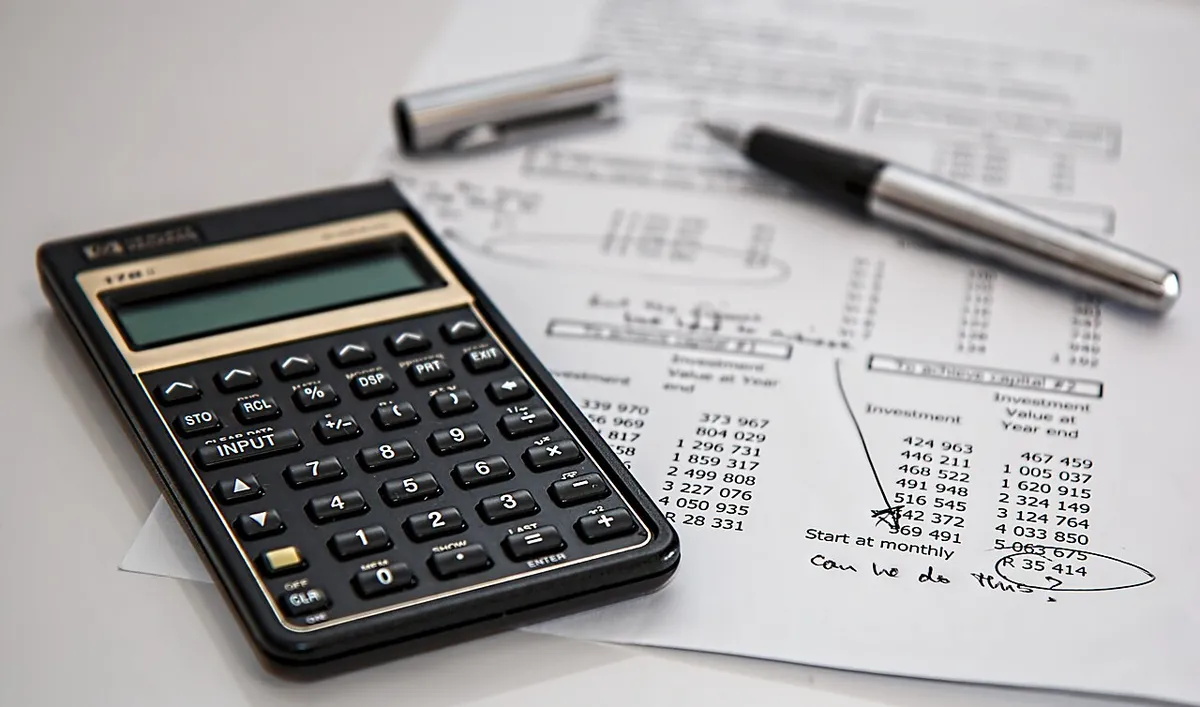
The calculator-at-desk photograph is by Kindel Media, via Pexels, Pexels License. The calculator-on-documents photograph is by Steve Buissinne, via Wikimedia Commons, license CC0. The document-review photograph is by Rawpixel Ltd, via Wikimedia Commons, license CC BY 2.0. All three were already in this site's licensed collection; all were converted to WebP and resized. No image on this page was generated by AI.


Sources
- U.S. Department of Labor — elaws FLSA Advisor, "Back Pay": recovery routes, liquidated damages, two-year / three-year limitations (webapps.dol.gov/elaws)
- U.S. Department of Labor, Wage and Hour Division — FLSA overview (dol.gov/agencies/whd/flsa)
- U.S. Department of Labor, Wage and Hour Division — Overtime (dol.gov/agencies/whd/overtime)
The calculator implements the two shortfall patterns described on this page and presents liquidated damages as the additional equal amount the FLSA provides for, in the Labor Department's own framing. Expected outputs were derived independently of the code and the engine is tested against them.
About this page
Informational content only — not financial, legal or tax advice, and not a government service. The calculator's result is an estimate only, from the figures you enter. Rules and figures were checked against the official sources listed on this page. Last reviewed: October 29, 2026. ⚑ English native editorial review: pending (owner gate).